
Landscaping of ceilings and slabs brings profound social and environmental changes, and comes in the wake of discussions on the international urban agenda
- Por Helena Degreas
- 20/04/2021 10h00
- Original: Jovem Pan
Fábio Motta/Estadão Conteúdo – 08/07/2004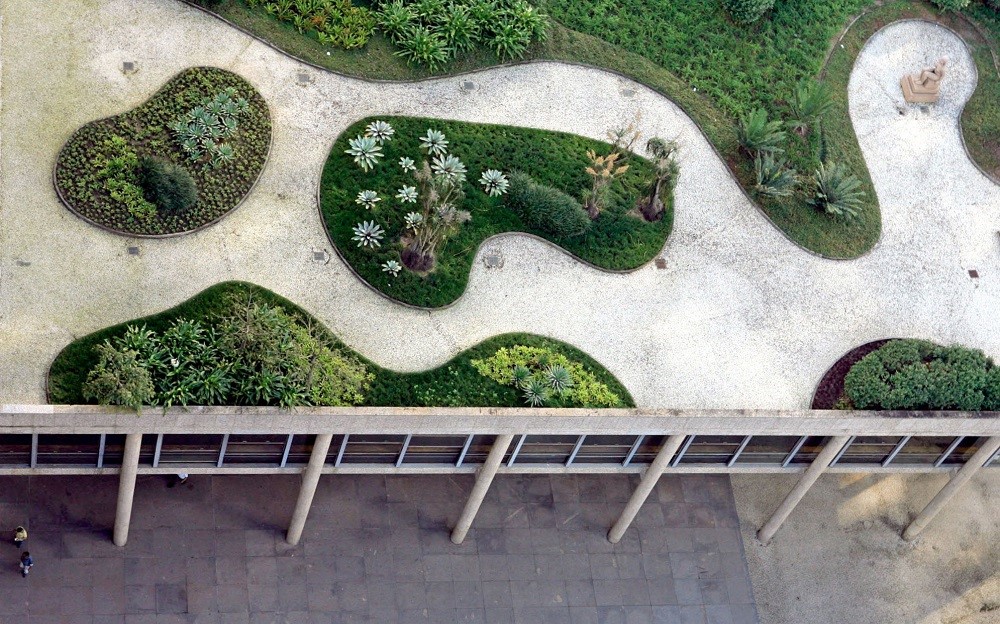
View of the Gustavo Capanema Palace building, former headquarters of the Ministry of Education (MEC), in downtown Rio de Janeiro What if, in addition to road afforestation, squares, parks, roundabouts and landscaped flowerbeds, public and private buildings had their original roofs redesigned as spaces intended for the recreation of the population and were like hanging gardens? What if these roofs, in addition to offering services such as urban gardens, swimming pools, sports courts, apiaries and urban mini-forests, were located in neighborhoods and communities lacking areas for public socialization? In recent years, many articles related to the art of landscaping roofs for buildings, as well as balconies, has been nostalgically associated with a “return to nature”, responsible for bringing benefits to the quality of life and comfort to residents. It is true, but the landscaping of ceilings and slabs brings social and environmental changes, and comes in the wake of the discussions that permeate the international urban agenda and that involve technical issues and solutions on urban sustainability. Based on a comprehensive view, green ceilings, hedges and green roofs are part of the architectural and urban solutions that promote climate stability and biodiversity conservation. They are also responsible for improving the local economy and providing new layers of social use to the tops of commercial buildings and services that partially contain equipment and pipes corresponding to the building's operating systems in addition to roofs. In other words: respecting the technical and construction specifications, it is possible to accommodate multifuncional uses through retrofit, or even, improvement, modernization and updating of existing buildings' facilities, contemplating new occupations for flat surfaces that serve only as a roof. It may seem new, but roof gardening has been a practice for centuries in towns and cities in the Mediterranean, Asia, Europe and the Americas. There are many examples. Peat covers in Iceland, the legendary Hanging Gardens of Babylon or on the islands bathed by the Aegean Sea, it is still common to find houses where the roof of one serves as a balcony for the other. The shapes result from the constructions embedded in the steep slopes that are superimposed on each other as a way of protecting this “warlike” Thalassocracy. It is a social use impregnated in the local culture. I remember washing my clothes by hand in my grandmother's kitchenette in Athens and spreading them on the clothesline on the roof of the low-floor building. Despite the pain of going up four floors loaded with baskets of wet clothes (a situation that she “took out better than me”), it was an immense pleasure to see the city from the top, even though it was strange to see the neighbors' clothes hanging next to mine… To me, now and them, smaller children would run around, dropping clothes on the floor. I got used to the screams of mothers, children and the exposure of my "intimacy". It is a social use impregnated in the local culture. The occupation of flat roofs or the roofs of buildings as spaces suitable for human use has always been conditioned by factors of geographic location that define temperature conditions, solar incidence, winds, temperatures and rains. Its forms, types and spatial compositions were part of a popular architecture, without an architect, which was built and composed based on social needs, local materials and techniques as well as the culture of each people. In other words, planting and use had the function of protecting people from climatic actions and serving some social functions. In other words, planting and use had the function of protecting people from climatic actions and serving some social functions. In the first decades of the twentieth century, a process of densification and spreading of cities began. With the development of new construction techniques such as reinforced concrete and, later, the incorporation of elevators that made buildings increasingly taller, structures such as pillar and beam associated with brick walls and flat slabs (which are nothing more than floors) buildings) marked the process of civil construction in Brazilian cities. If, on the one hand, a process of vertical densification started in some urban regions, on the other hand our tropical climate marked by hot, sunny days, and interspersed with rainy days, delayed the incorporation of the garden roofs recommended by the architect Le Corbusier (icon of the modern architectural movement) in their coverage. In Brazil, the use of flat slabs on the roofs of buildings had to wait for the improvement of waterproofing processes. In the absence of adequate solutions to leaks and internal thermal issues, the roofs of modernist buildings (between the 1930s and 1940s) were being protected with the construction of traditional roofs for Brazilian colonial houses: wooden structure, ceramic tiles (French) , paulistinha, among others) in addition to the well-known cement wavy tiles. In the city of Rio de Janeiro, the Gustavo Capanema Palace, also known as the former Ministry of Education and Culture (MEC), was designed by Le Corbusier and the team formed by Oscar Niemeyer, Lúcio Costa, Affonso Eduardo Reidy, Jorge Machado Moreira, Carlos Leão and Ernani Vasconcelos and built between the years 1937 and 1943. On the marquee, Roberto Burle Marx designed a huge garden terrace in line with the precepts of modernist “new architecture”. He continued to design his garden terraces in countless other buildings, such as the Museum of Modern Art in Rio de Janeiro or the gardens of Banco Safra in São Paulo. Currently, green roofs have been incorporated into the Environmental Plans of several cities in the world and are an integral part of urban green infrastructure. From them, open urban spaces, in addition to diverse natural areas, work as a kind of interconnected network that, through the adoption of technologies that allow environmental control, climate regulation, the generation of income through the creative economy and recreational uses, can bring benefits to the population and cities. The city halls of Barcelona (Terrats Guide Vius i green roofs) and London (Living Roofs and Walls) created guides and public incentives that collaborate in the development of these new urban spaces, with the objective of contributing to the achievement of quantitative indicators assumed in the Agreement of Paris. In the last 10 years, the gardening project for building slabs in the city of London has added up to an area of 1.5 million m² of roofs; more ambitious, Barcelona presents a plan that aims to landscaping most of the more than 60% of the roofs of existing buildings in the city, occupying them with roofs with cultivable spaces for urban agriculture as in an agripolis. In the city of Copenhagen, Denmark, the use of the roof of buildings as accessible garden roofs has been mandatory in new buildings since 2010. In addition to garden terraces and green ceilings, the concept is broad and aims to disseminate the use of roofs and flat slabs of residential and commercial buildings for multifunccional purposes. These new types of free public urban spaces are inserted in an environmental, social and economic dynamic linked to cities, urban uses and the mobility network on foot, transforming into habitable spaces ready to receive the population. The English version of this Report is a free translation from the original, which was prepared in Portuguese.
 Helena Degreas